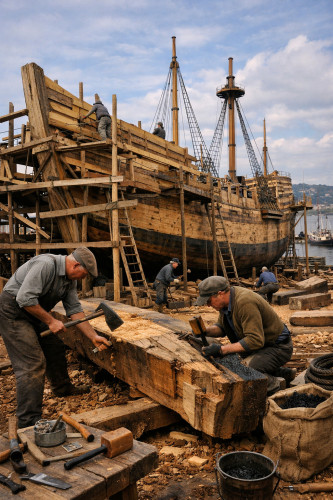
The Construction and Launch of Mayflower II at Brixham (1955–1956)
The building of Mayflower II at J.W. & A. Upham Ltd., Brixham, between 1955 and 1956, represents one of the most significant post‑war Anglo‑American commemorative shipbuilding projects. Conceived by British journalist Warwick Charlton, the vessel was intended as a permanent symbol of gratitude for American support during the Second World War and as a gesture of renewed cultural partnership between the United Kingdom and the United States. Charlton’s initiative, developed through Project Mayflower Ltd., was financed not through public subscription but through British commercial sponsorship, with companies donating materials and products in exchange for publicity and inclusion in the “treasure chests” later exhibited in New York.
The Upham Shipyard in Brixham—already renowned for more than 150 years of wooden‑shipbuilding expertise—was selected as the construction site. The ship’s design was produced by William A. Baker, an American naval architect who had spent five years reconstructing the likely form of the 1620 Mayflower using Pilgrim accounts such as Bradford’s History of Plymouth Plantation and Mourt’s Relation (1622), supplemented by comparative evidence from 17th‑century maritime treatises and contemporary ship illustrations. Baker’s plans were then executed by Upham’s shipwrights using traditional wooden construction techniques, including solid oak timbers and tarred hemp rigging.
Mayflower II was laid down on 27 July 1955 and launched at Brixham on 22 September 1956, christened by Stewart Upham and Reis Leming. The vessel was built as a faithful, though necessarily interpretive, reconstruction of a 17th‑century English merchant ship, with dimensions of approximately 106 ft (32 m) in length and a displacement of around 236–238 tons. The project was jointly supported by British sponsors and Plimoth Plantation (now Plimoth Patuxet Museums), which provided historical research and later accepted the ship as a gift.
Following her launch and fitting‑out, Mayflower II departed Plymouth, Devon, on 20 April 1957 under the command of Captain Alan Villiers, completing a 54‑day transatlantic crossing that closely followed period sailing practices. The ship arrived in Plymouth, Massachusetts, in June 1957 and was subsequently exhibited in New York before being transferred permanently to Plimoth Plantation. The vessel has since become an enduring educational and commemorative symbol, undergoing multiple restorations while remaining one of the most historically significant replica ships of the 20th century.
References
- Baker, W.A., design and research background; Upham Shipyard selection; Charlton’s project origins and sponsorship model. Voyaging Through History: Mayflower II (Brixham, 1957).
- Construction details, dates of laying down (27 July 1955) and launch (22 September 1956), christening, dimensions, materials, and voyage under Alan Villiers. Mayflower II, Wikipedia.
- Additional corroboration of construction period (1955–1957), traditional wooden techniques, and Baker’s design methodology. Mayflower II, Grokipedia (fact‑checked summary).